
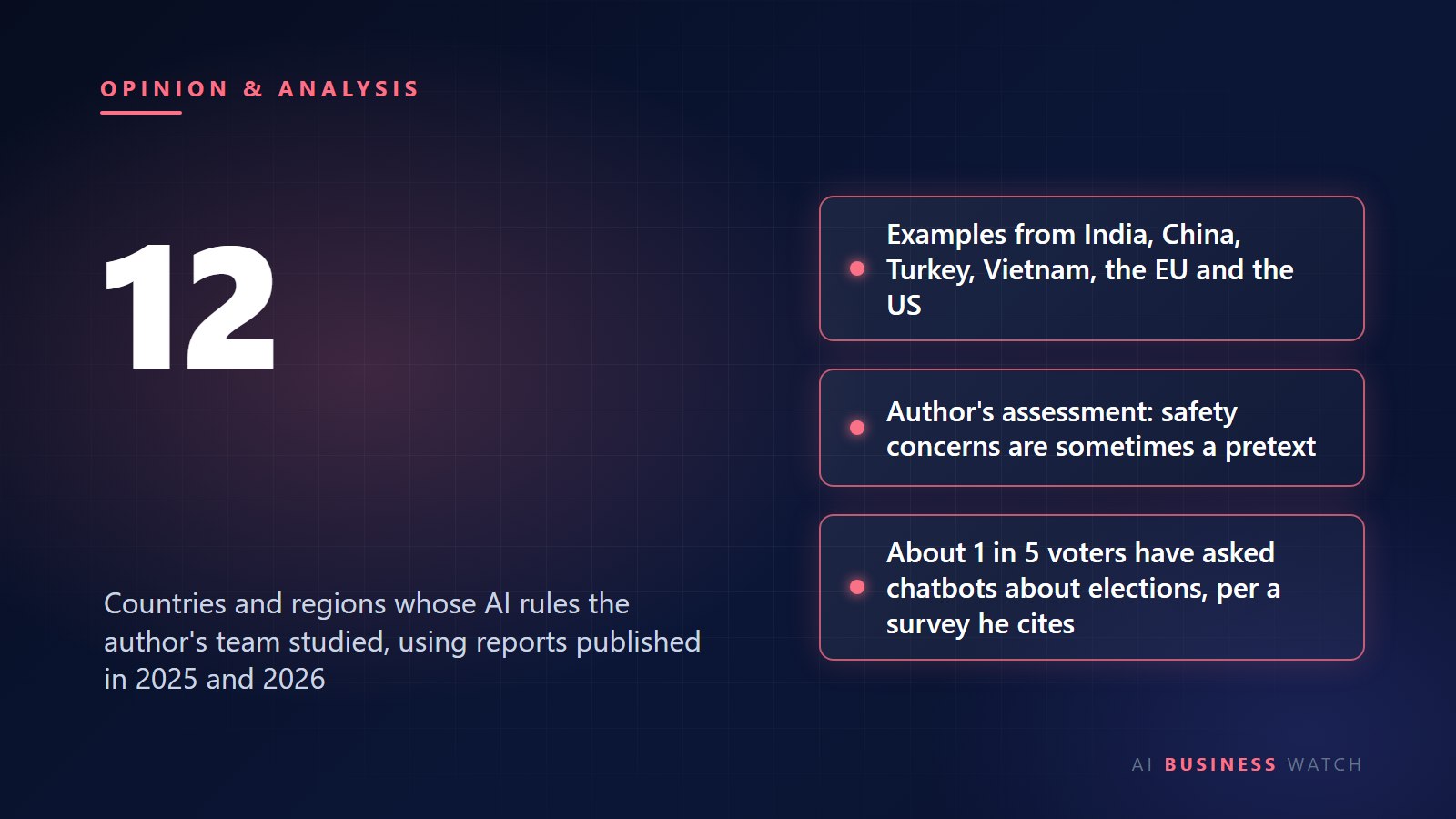
Jordi Calvet-Bademunt, a research fellow and visiting scholar of political science at Vanderbilt University, argues in The Conversation on October 20 that some governments invoke legitimate AI safety concerns to control political discussion. He is affiliated with The Future of Free Speech, a nonpartisan think tank at Vanderbilt, which he says keeps full independence over its work. The conclusion is his assessment, and the examples are drawn from his team's study.
The scope
The article cites a recent survey finding that about one in five voters has asked AI chatbots about elections and politics ahead of the US midterms. His team studied how governments in 12 countries and regions regulate AI, using reports published in 2025 and 2026, and found that governments often rely on existing rules, such as national security or anti-state propaganda laws, instead of new AI laws.
The examples
In India in 2024, Google's Gemini said some experts say yes when asked whether Prime Minister Narendra Modi's policies were fascist, and the government then required official permission before releasing unreliable AI models, a requirement authorities later dropped. China requires AI models to uphold socialist core values. In Turkey, a court blocked posts by Grok that allegedly insulted President Erdogan, Ataturk and religious values. In Vietnam in December 2025, a court sentenced two activists living in Germany to 17 years each for spreading anti-state material, with prosecutors accusing them of using AI to fake voices and images of Vietnamese leaders.
Europe and the United States
The EU AI Act requires AI-generated content to be marked, and in August 2026 the EU placed ChatGPT under the strictest tier of the Digital Services Act, requiring OpenAI to address systemic risks including risks to elections. The Dutch Data Protection Authority tested four chatbots before the 2025 national election and found the political middle ground virtually disappears in their voting advice. In the US, a July 2025 executive order requires government-purchased AI to be truth-seeking and ideologically neutral, and dozens of states have restricted AI-generated political deepfakes, with California and Hawaii laws blocked by US courts on First Amendment grounds.
His view
Calvet-Bademunt writes that truth-seeking sounds neutral but can mean different things to different people, and that mandates to seek truth are often driven by ideological belief systems. For voters, he advises treating chatbot election answers as a starting point, since governments at home and abroad may try to influence them. He concludes that AI responses should not replace critical thinking at the ballot box.
Source: The Conversation. This is an AI Business Watch summary of the original article.