
Oxford researchers want happiness added as a third goal for AI companies, alongside economic growth and risk mitigation. The Register's Paul Kunert reported on October 21 on the paper, titled “Optimising for happiness in EU technology policy to repay public subsidies for AI,” published in Royal Society Open Science. The lead author is Professor Sandra Wachter of the Oxford Internet Institute, and the page names no other authors.
The argument
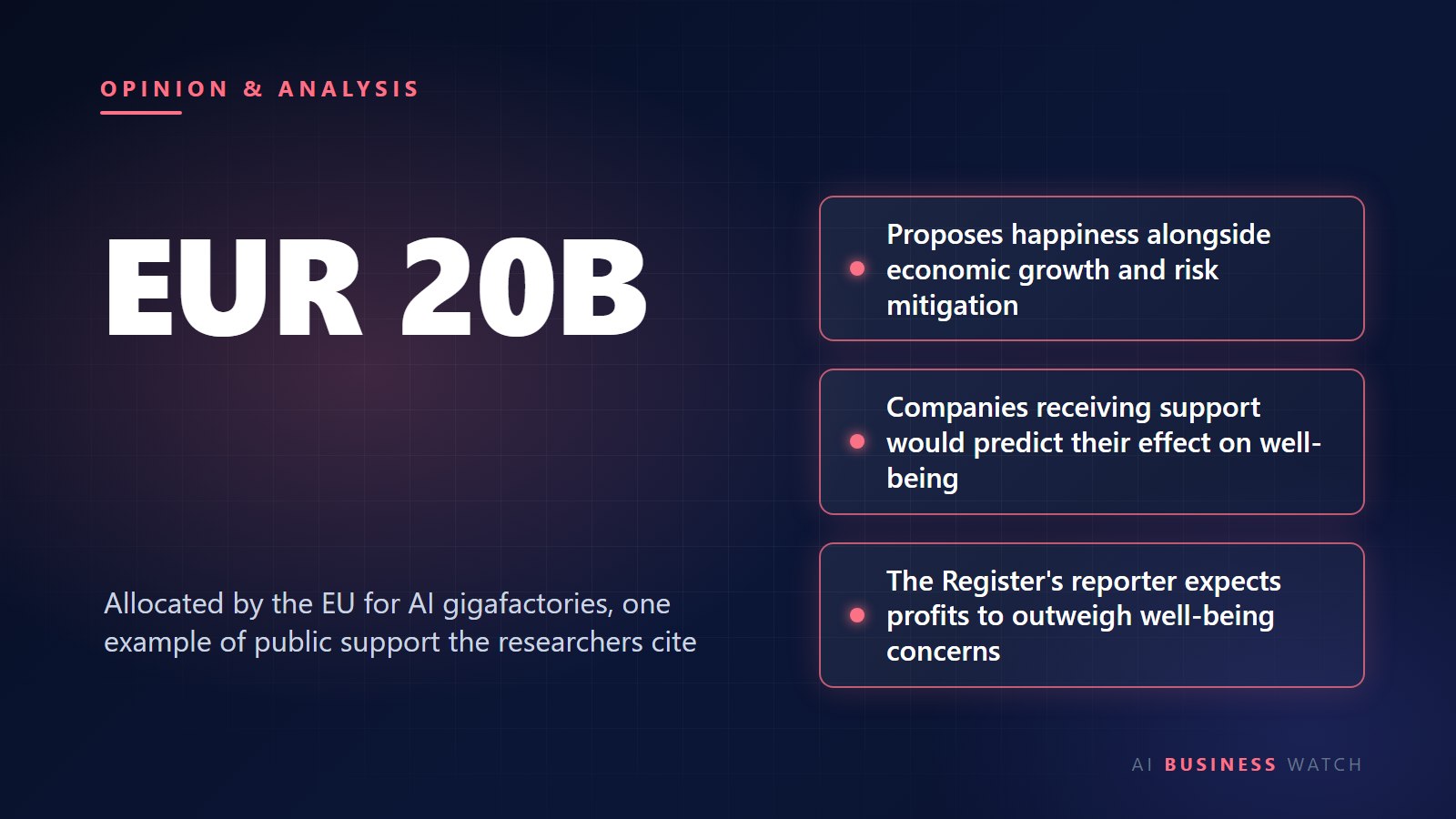
The researchers say the public already funds AI through subsidies, tax breaks and access to land, water, energy, infrastructure and data, so it should share in the benefits. Wachter said: “We believe people deserve technology that increases their happiness,” and that “The public already pays for AI through subsidies, resources, and data.” Under the proposed approach, companies benefiting from public support would be expected to predict how their technologies will improve happiness and be held accountable for it. They add that making technology less harmful is not the same as making it socially beneficial.
The figures
The paper notes that the EU has allocated €20 billion for AI gigafactories, and that GenAI4EU and the Digital Europe programme are using €700 million through Horizon research projects.
The harms they list
Chatbots that imitate human emotion may reduce the value people place on real connection, heavy AI use could dull skills, and AI influence could make independent choices harder. Data centers threaten land, water and green spaces, denser servers may raise household electricity bills, and higher-margin chip priorities may raise DRAM and NAND prices. The researchers note that difficulty obtaining data from model makers and cloud providers makes environmental damage hard to measure.
The reporter's view
Kunert notes that Anthropic warned this year of human extinction risk without controls and that Anthropic and OpenAI both raised mass unemployment concerns last year, and concludes that profits will likely outweigh well-being concerns. That conclusion is the reporter's opinion.
Source: The Register. This is an AI Business Watch summary of the original report.