
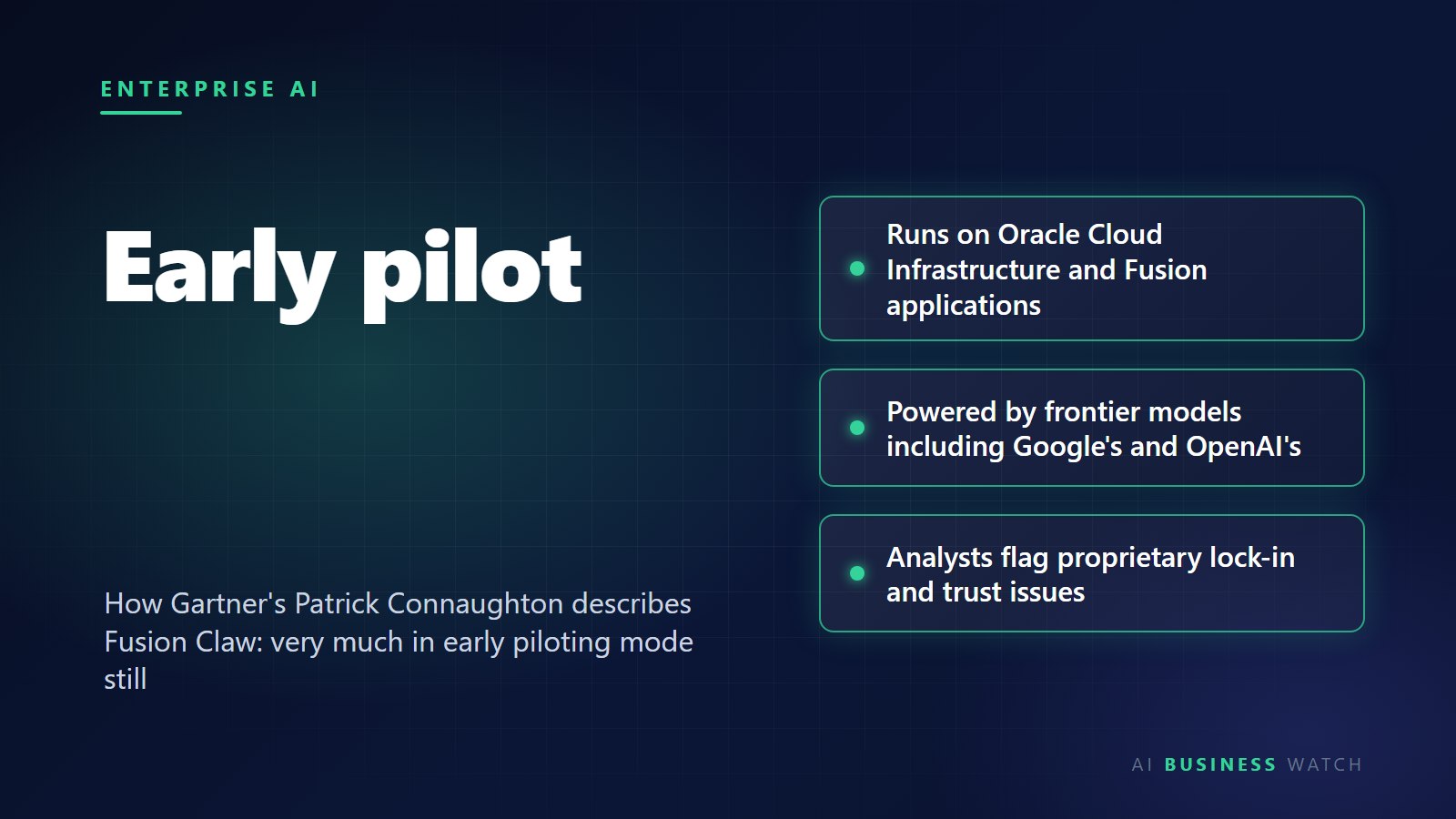
Oracle introduced Fusion Claw, a runtime that governs AI agents automating business processes, The Register's Lindsay Clark reported on October 9. It runs on Oracle Cloud Infrastructure, integrates with Oracle Fusion applications and targets ERP, finance and supply chain management. It is powered by frontier models, including those from Google and OpenAI, with support for other models planned.
How it governs agents
According to Gartner, Fusion Claw provisions isolated containers with specific authority limits, business object states and policy guidelines. It separates reasoning from compute: agents define execution logic once, while deterministic compute engines handle calculations, so large volumes of records do not pass through expensive LLM context windows. Oracle also offers prebuilt applications for ledger readiness, staffing plans and shipment consolidation. CEO Mike Sicilia said Fusion Claw moves “from AI assistance to execution.”
Analyst views
Gartner said Oracle is rebuilding its application foundation around native agentic workflows instead of bolting AI onto legacy systems, and recommended including Fusion Claw in RFPs for AI agent deployments. But Patrick Connaughton, Gartner's chief of research for enterprise applications, warned it is “very much in early piloting mode still.” Forrester principal analyst Craig Le Clair said: “we have many trust issues to solve before agentic systems can be trusted.” Forrester noted Fusion Claw is offered under per-user or per-employee pricing as well as consumption-based models.
The lock-in question
Oracle's version is proprietary and tightly coupled to Fusion applications on OCI. Le Clair said enterprise architects are key to avoiding lock-in, citing data residency and integration needs, and added: “If the domain strength is strong enough, lock-in may be OK.” He argued that cloud domains like Oracle suit generic functions, while complex, transformative custom agents should use custom frameworks and hyperscaler platforms.
The bottom line
The Register concludes that organizations already invested in Oracle may welcome tighter governance and lower running costs, while those with a broader mix of suppliers may find the ties harder to justify.
Source: The Register. This is an AI Business Watch summary of the original report.