
Executives from Honeywell and Ecolab described the limits of AI in the physical world at the Fortune AIQ Summit at the New York Stock Exchange on October 1. Fortune's Nick Lichtenberg reported the discussion on October 2, with Emily Forlini moderating.
Accuracy and cost
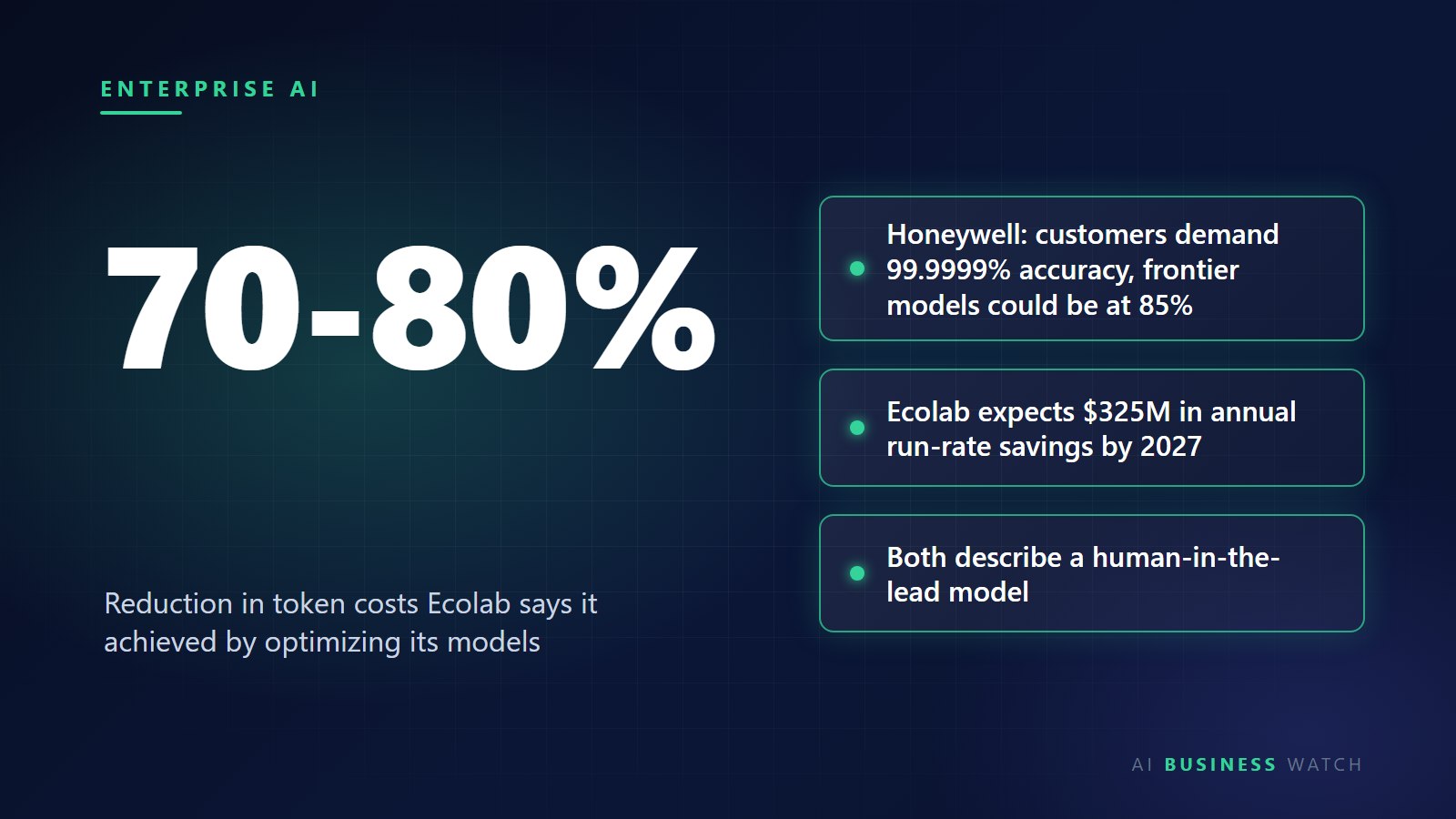
Suresh Venkatarayalu, chief technology officer of Honeywell Technologies, said customers “really demand 99.9999%,” while frontier models “could be at 85%.” AJ Wijesinghe, Ecolab's chief AI officer, said running the best model on high-volume work made “the tokenomics go off the roof,” and: “Sometimes it's more expensive than having humans.” Ecolab optimized its models and cut token costs by about 70% to 80%, using frontier and open-source models including Anthropic's Claude and OpenAI's. Wijesinghe said: “Sometimes you don't have to have the fastest car.”
Human in the lead
Wijesinghe described a human-in-the-lead model, saying agent technology is not matured enough to run at scale alone. Venkatarayalu said buildings are “mission critical and safety critical” and that “you cannot afford to have a building shut down for one and a half hours.” Over-the-air upgrades are coming to commercial buildings, but with an operator involved. He described a move toward a semi-autonomous world and said autonomy is not about removing people.
Examples
Honeywell's see, think, act and learn framework catalogs building assets such as HVAC, fire control, security and access control and connects them over BACnet. It is also exploring AI for chemistry, such as catalyst formulation, and customers who achieved 7% energy savings now ask whether AI can deliver 30% to 40%. Ecolab uses sensors in dishwashers, pest traps and water systems to reduce service visits and predict maintenance, and manages water for chip production, power and cooling in AI infrastructure.
Value
Wijesinghe said individual AI adds little measurable enterprise value, vertical AI adds some, and horizontal AI, which works backward from outcomes across functions, adds the most. Ecolab expects $325 million in annual run-rate savings by 2027. Data, process readiness and cost discipline must all be strong, he said: “If one is heavier than the other, then you don't get the value.” Honeywell is fine-tuning open-source models partly because customers want data and model sovereignty, and works with Nvidia's Nemotron team without an official partnership, per the article's correction.
Source: Fortune. This is an AI Business Watch summary of the original report.