
Melissa Lee, a senior lecturer in the School of Mathematics at Monash University, writes in The Conversation on October 9 that OpenAI's release of AI-generated mathematics has left mathematicians in shock. This summary separates the reported facts from her opinions.
What was released
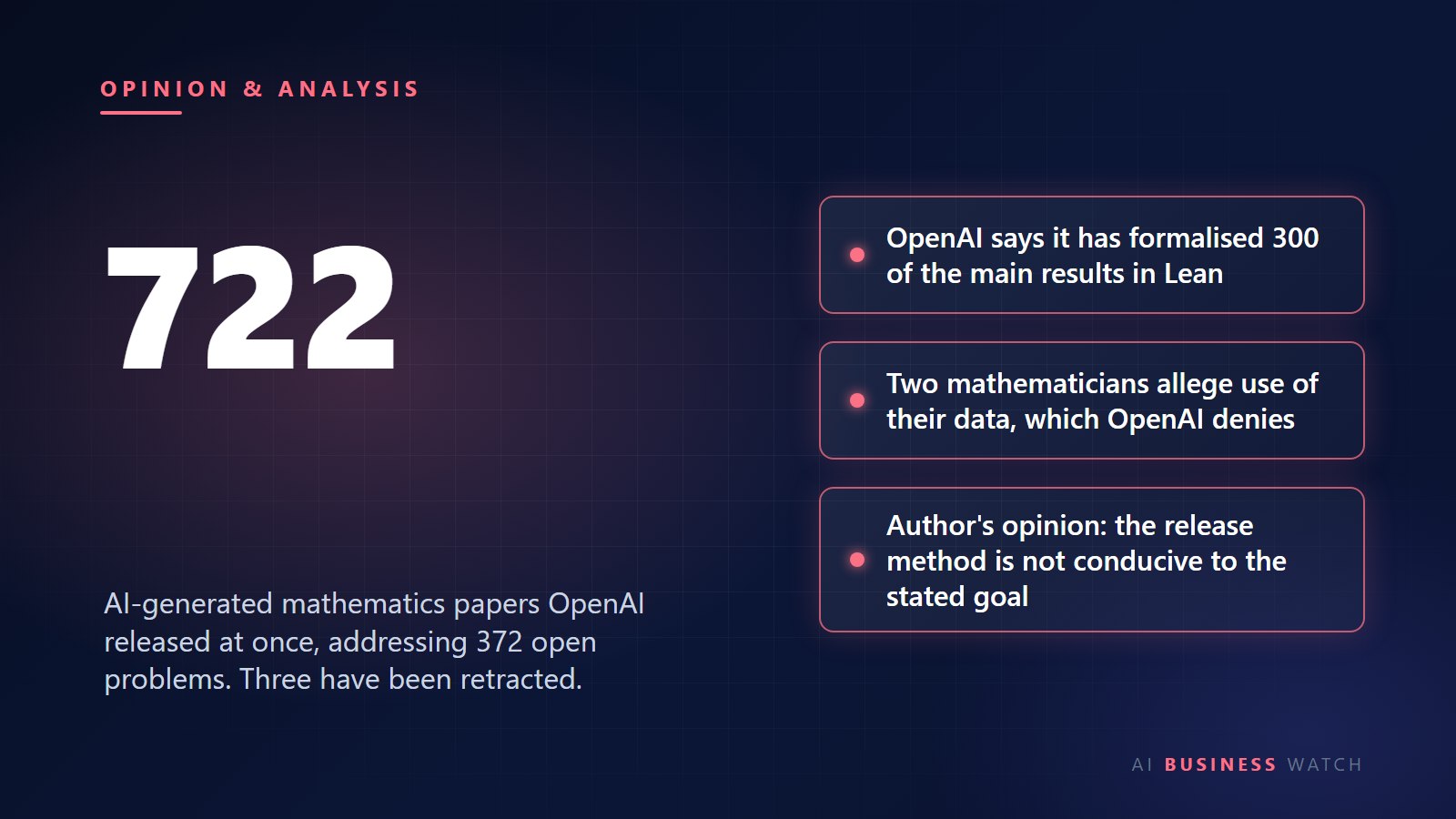
Earlier that week, OpenAI published hundreds of mathematical results, which it said could push the frontier of human knowledge, most produced by an unreleased AI model. The release comprises 722 papers addressing 372 open problems across algebra, geometry and theoretical computer science. OpenAI retracted three papers because of an elementary error and amended several others because mistakes invalidated their results. Some papers claim advances on the Riemann hypothesis and the Birch and Swinnerton-Dyer conjecture, each a Millennium Prize Problem with a $1 million bounty. OpenAI says the release aims to enable further progress in mathematics and that it has formalised 300 of the main results in Lean, though past AI-generated formalisations, including one of Navier-Stokes, have shown problems.
The earlier dispute
In September, OpenAI published a claimed solution to a case of the Navier-Stokes problem. Mathematicians Tristan Buckmaster and Levent Alpoge, who had been working on it, alleged that OpenAI accessed their data and used their ideas, and spent about $15 million in computing power. OpenAI denies the allegations. Reports say OpenAI hopes for a valuation of up to $1.4 trillion ahead of a planned stock market launch.
Reactions
Lee says an unnamed senior colleague found one of his favorite solved problems and judged the accompanying paper so unintelligible that, as a journal editor, he would have binned it. She asked ChatGPT about one high-profile result and it called it a serious hallucination that should never be cited as a proof without a complete expert audit. Linked social posts range from calling the release the most significant moment in mathematical history to calling it a giant pile of turd dumped at mathematicians' doorstep.
Her opinion
Lee argues the release method is not necessarily conducive to the stated goal, that OpenAI may be seeking to move past the Navier-Stokes controversy, and that the mathematical results could lend credibility to claims about approaching artificial general intelligence, which could help the valuation. The real test will be community examination, which is slow, and the retractions suggest insufficient vetting. She raises concerns about who bears the labor of interpreting arguments that initially read as AI slop, and about early-career researchers whose work could be scooped.
Source: The Conversation. This is an AI Business Watch summary of the original article.