
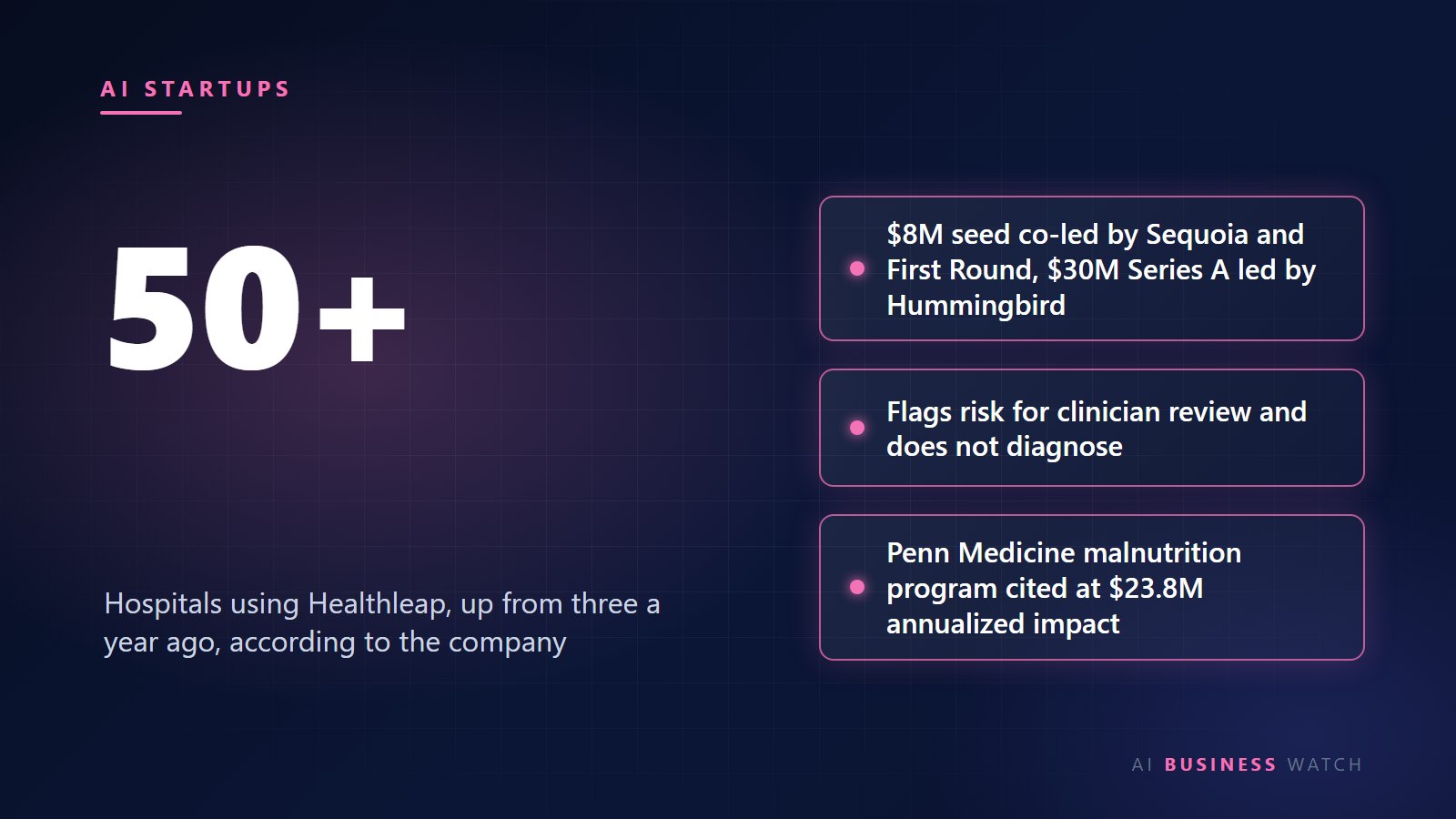
Healthleap raised $38 million across a seed round and a Series A, TechCrunch's Ram Iyer reported as an exclusive on October 7. The $8 million seed was co-led by Sequoia Capital and First Round Capital, and the $30 million Series A was led by Hummingbird Ventures. The valuation was not disclosed.
What the platform does
Healthleap's AI reads patient records to flag admitted adults who may have conditions such as malnutrition or delirium. It connects to hospital electronic health record systems, where language models extract mentions from clinical notes, which are combined with labs and vitals in risk models. It does not diagnose. It highlights patients for clinician review. Analysis runs nightly and risk scores appear each morning in the care team's workflow. CEO Josiah Meyer said: “Each night, we analyze every adult inpatient's record,” and noted that “the most telling signs sit in clinicians' written notes.” Malnutrition and delirium screening are deployed, and programs for aspiration pneumonia, pressure ulcers and congestive heart failure readmission risk are undergoing clinical validation.
The company
Siblings Jemima and Josiah Meyer founded Healthleap in South Africa in 2022. Jemima originally built a clinical nutrition tool for dietitians before the company pivoted to a general-purpose platform. Named customers include Penn Medicine, Cedars-Sinai, Intermountain, Houston Methodist and Emory Healthcare.
The company's claims
Healthleap says its hospital partners grew from three to more than 50 over the past year and that revenue grew more than 10 times over the same period, without specifics. It says every customer has seen at least a 5x hard ROI, and some over 20x annual total ROI. At the Hospital of the University of Pennsylvania, it says the malnutrition program produced $23.8 million in annualized impact, $6.3 million from reimbursement and $17.5 million from shorter stays. These are company claims.
Business model and plans
Contracts run three years and are priced by licensed bed count, with an outcome-based pricing model as well. Funds will go to engineering, product, sales and customer success, with goals of covering more than 40 major conditions and expanding into outpatient and home care.
Source: TechCrunch. This is an AI Business Watch summary of the original report.