
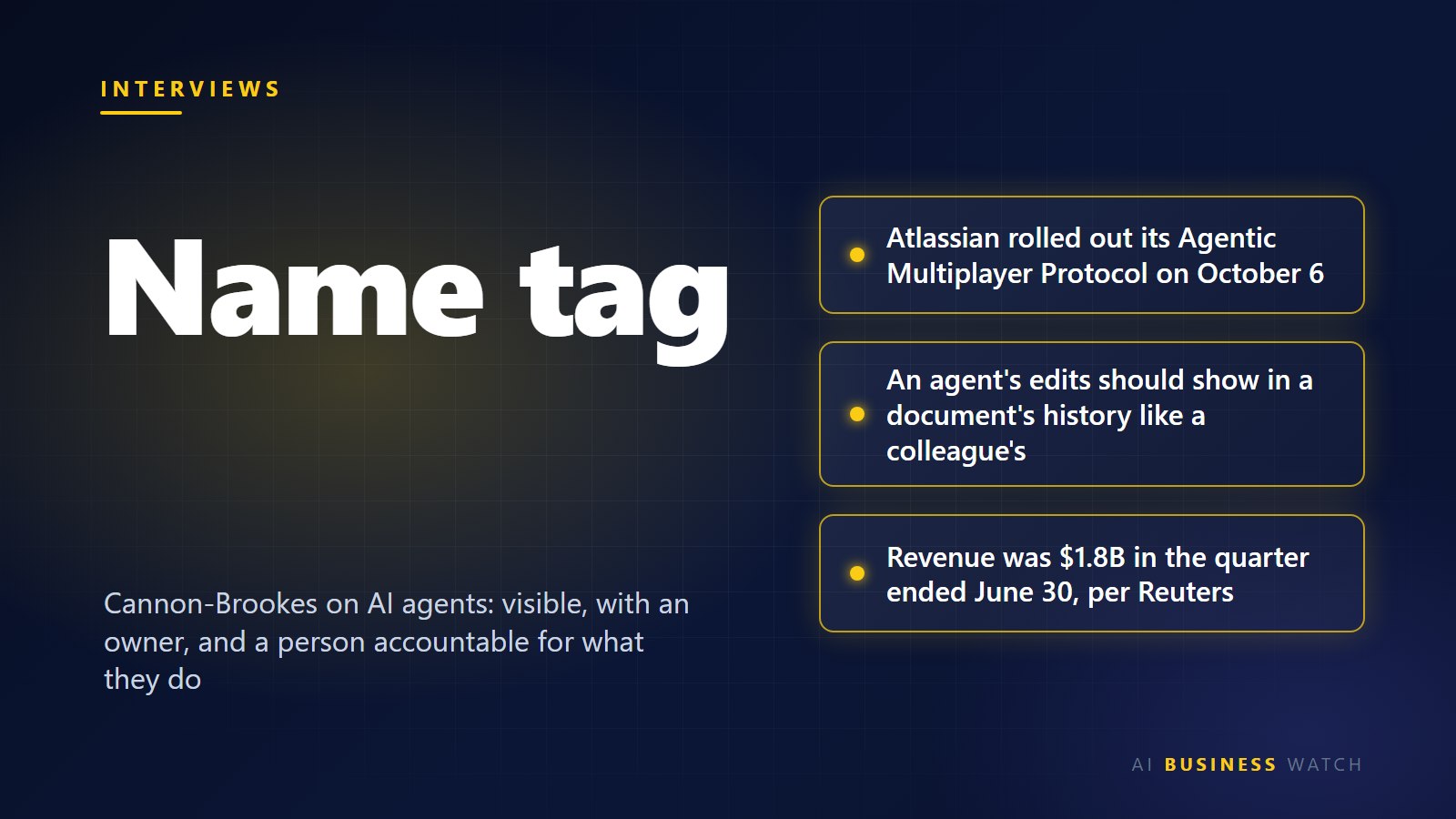
Atlassian CEO Mike Cannon-Brookes spoke with Fortune on the sidelines of the Singapore Grand Prix, and the interview was published October 19 by Fortune's Angelica Ang. He argued that AI agents need to be visible members of a team, with a human responsible for what they do.
The protocol
Atlassian rolled out its Agentic Multiplayer Protocol on October 6. It is a control plane across Atlassian's platforms that makes AI agents visible, governed members of work teams, with distinct profiles and owner attribution. An agent's edits should appear in a document's history the same way a colleague's edits do.
On accountability
Cannon-Brookes said responsibility rests with the person using the tool. Comparing an agent-made output to a person using ChatGPT, he said: “The accountability is with Mike. It has to be with the end user, ultimately.” He added: “You have to be able to see who did what when.” He objected to systems that credit a tool, such as Codex, with an edit that a person made.
Personal versus workplace agents
Personal agents, including Meta's Muse and OpenAI's Dots, are now reaching the market. He said such products can hide what an agent is doing behind the scenes: “If you're making something on Muse, it's probably just for you.” In a workplace, he said, “there's a lot of conversation around permissions, security, and compliance.” His example was an employee who builds a visual chart from internal documents and accidentally shares sensitive information with people who should not see it.
Interface design
He said AI can do “amazing, crazily super-powerful things,” but most people use it for basic tasks because of the interface. He compared this to word processors: without toolbars, “everyone's documents end up looking like plain text.” Atlassian launched Rovo in 2024 as an in-house AI assistant, and he said the company has had to invent a lot of new foundational design patterns that feel familiar.
Business context
Per Reuters, Atlassian's revenue was $1.8 billion in the quarter ended June 30, above the analysts' average estimate of $1.7 billion. In March the company cut about 10% of its workforce, roughly 1,600 employees, as it shifted toward AI and enterprise sales. On Australia, Cannon-Brookes said the country is roughly 1% of the world's GDP and needs to be 1% of the world's technology production.
Source: Fortune. This is an AI Business Watch summary of the original interview.