
Wall Street keeps asking whether each new AI bubble warning is the one that matters. In a piece published October 17, Fortune's Jason Ma lists the earlier scares: Nvidia's climb through successive market-cap milestones, hyperscaler borrowing, the DeepSeek shock in early 2025, Sam Altman's admission that a bubble exists, Michael Burry's bearish bets, the Iran war, a South Korean market meltdown and worries about circular funding deals. Earnings kept rising and stocks hit record highs. The current worry is whether trillions of dollars in AI spending will pay off, and it centers on CoreWeave.
The CoreWeave signal
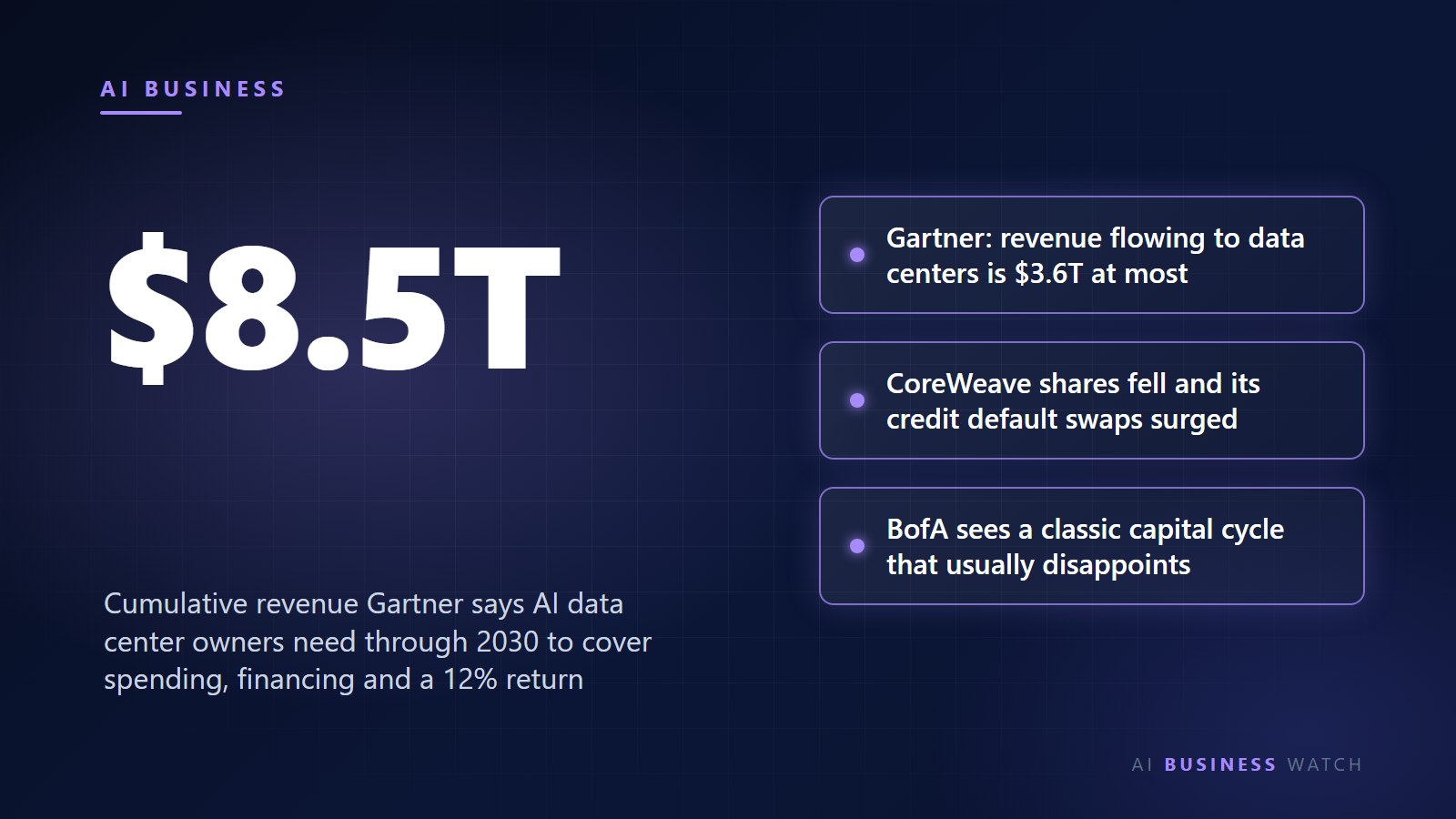
CoreWeave, a neocloud computing firm, saw its stock fall and its credit default swaps surge. Dan Greenhaus, a strategist at Solus Alternative Asset Management, told CNBC on October 16: “How many canaries have we killed in the coal mine over the last three years.” He sees CoreWeave as no more a signal of imminent bust than earlier headlines were, though he calls its unsecured debt “the riskier of the riskier AI buildout play.” Bond yields have hit their highest levels in more than 20 years amid the Iran war and oil prices, and the Fed is hiking again to fight inflation. AI companies increasingly rely on bond markets for financing.
The companies respond
CoreWeave CEO Mike Intrator said markets can misunderstand and act irrationally, and wrote in a memo that the deal backlog is more than enough to cover debt obligations. Nvidia CEO Jensen Huang, whose company is a CoreWeave shareholder, told Bloomberg: “CoreWeave's strength is improving every day.” He said no financial backstop is needed and that its cost of capital is falling. Both speakers have a stake in the outcome.
The forecasts
Gartner estimated on October 14 that AI data center owners need $8.5 trillion in cumulative revenue through 2030 to cover capital spending, financing costs and a 12% return, while total enterprise and consumer AI revenue flowing to data centers will be $3.6 trillion at most. Fortune cites more than $4 trillion in asset value exposed to write-down risk through 2032, though a Gartner release it links to references $3.5 trillion by 2030, so the figures differ. Bank of America, in a Friday note, argues the boom follows a classic capital cycle that usually ends in disappointment even when the technology meets expectations: early high margins drive overinvestment, excess capacity and more competition, including from Chinese open-weight models. It says business AI spending has dipped as higher token volumes fail to offset lower token prices, and warns of monetization disappointment in the face of intense competition.
Where the article lands
Fortune takes no explicit position. Earnings growth, record highs, yield levels and Taiwan Semiconductor's results suggesting robust demand are the data points. The forecasts and the cycle thesis are projections, and the reassurances come from interested parties.
Source: Fortune. This is an AI Business Watch summary of the original report.