
Nvidia has released new open models aimed at running AI agents in the enterprise and on personal computers. TechCrunch's Julie Bort reported the launch on October 19, saying Nvidia made the models available the previous Thursday.
The models
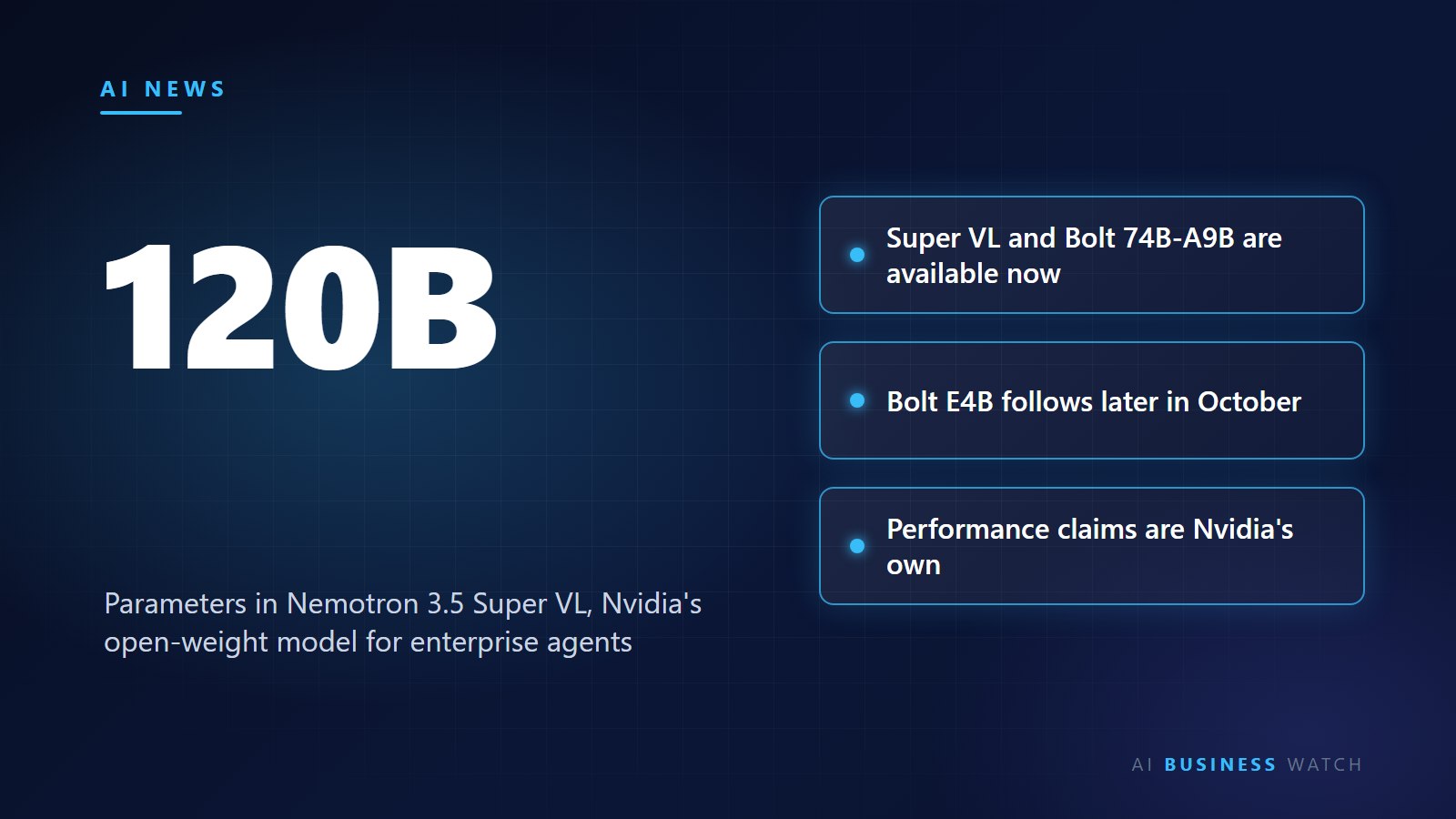
Nemotron 3.5 Super VL is a 120-billion-parameter open-weight model for enterprise agents. Nvidia says it uses fewer parameters than Nemotron 3 Ultra but delivers similar accuracy on instruction-following and tool-use tasks. Nemotron 3.5 Bolt 74B-A9B is a 74-billion-parameter model for local agentic work, meant to balance speed and reasoning across multistep reasoning, tool calling and web browsing. Bolt E4B, the smallest, is aimed at conversational agents. Super VL and Bolt 74B-A9B are available now, and Bolt E4B arrives later in October.
Where they run
The Bolt models are designed to run locally on AI PCs with the Nvidia RTX Spark chip and on workstations running DGX Spark. Those machines, aimed at consumers, programmers and enterprise knowledge workers, are being released through partners including Microsoft and Dell.
Nvidia's performance claims
Nvidia says that when post-trained on specific agentic tasks, Super VL completes them faster than competing models from Anthropic and OpenAI, which the article names as Opus 5, GPT 6.1 Sol, Luna and Astra. The tasks include document intelligence, financial accounting, scientific experimentation, medical insurance claims and security attack resilience. TechCrunch does not independently verify these claims. Nvidia named Skydance, EY, Ramp, Crowdstrike, Perplexity and Salesforce as users of Super VL.
What Nvidia says about openness
Kari Briski, Nvidia's vice president of open models and software, said: “Unlike closed frontier models, organizations can post-train Super VL on their own data.” On local use, she wrote that PC users can delegate everyday projects without sending those workloads to the cloud.
What the article leaves out
The report does not state license terms or architecture details beyond parameter counts. It notes that AI labs are increasingly turning to chips from AWS (Trainium), Cerebras and their own designs.
Source: TechCrunch. This is an AI Business Watch summary of the original report.