
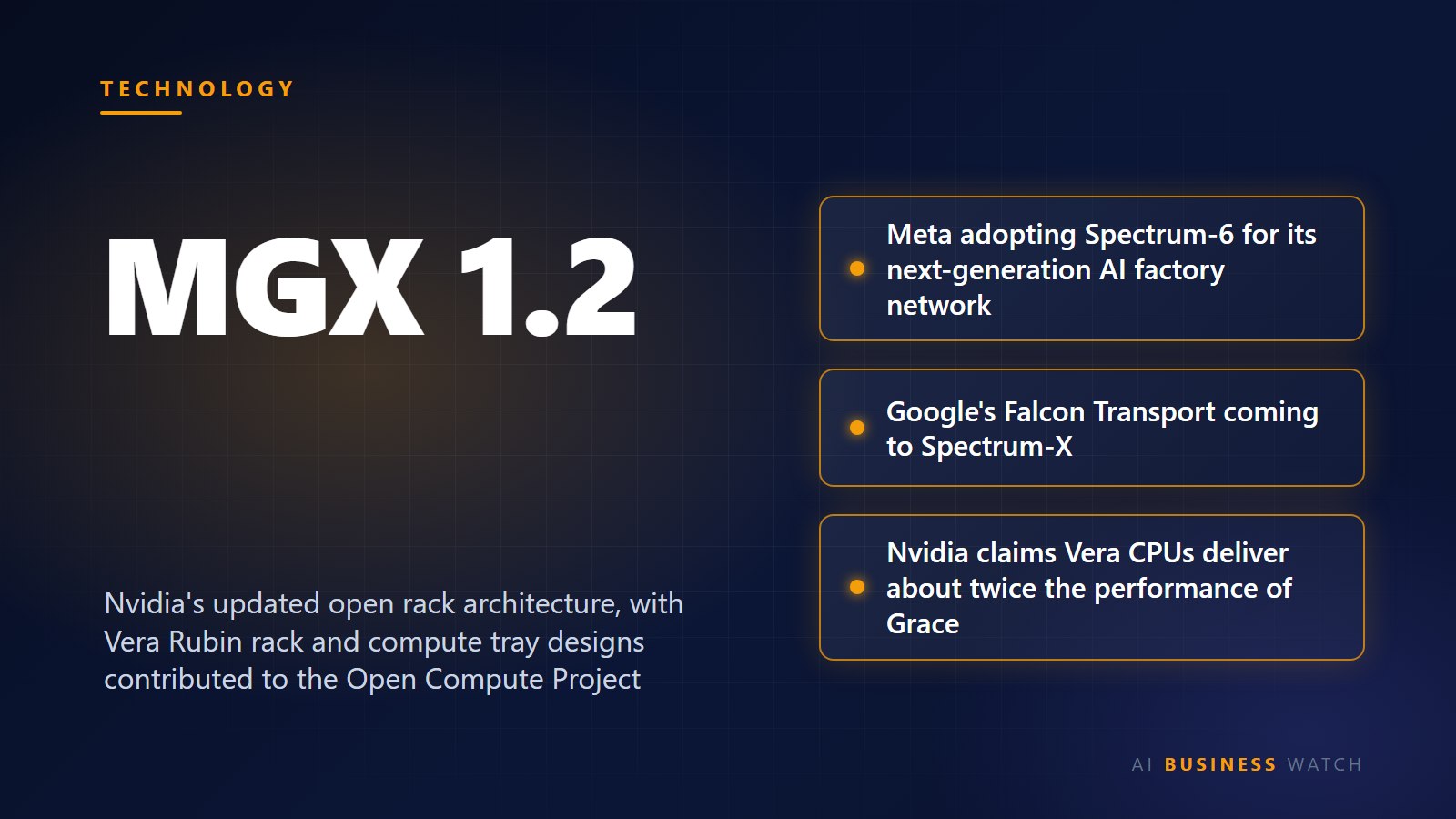
Nvidia announced new partnerships and open-source contributions at the Open Compute Project Global Summit in San Jose, framing the work as groundwork for agentic AI infrastructure. SiliconANGLE's Kyt Dotson reported the details on October 12. The performance figures are Nvidia's claims.
Open rack designs
Nvidia's main move was contributing Vera Rubin rack and compute tray designs to the Open Compute Project through its MGX architecture, giving system builders shared blueprints for rack layouts, networking, power and cooling. Joe DeLaere, Nvidia's AI infrastructure solutions lead, said: “The real bottleneck for the industry right now is how fast the world can manufacture and deploy AI factories.” MGX 1.2 supplies open components for liquid cooling and interoperable rack-level interconnects, plus modular liquid-cooled fanless I/O bays and standardized power.
The CPU's role
The Vera CPU rack design extends MGX into agentic workloads. The article notes that CPUs orchestrate networking, data movement, sandboxed execution and computation while GPUs handle parallel AI work. DeLaere said: “Between model calls, agents need to do orchestration.” Nvidia claims Vera CPUs deliver about twice the performance of its previous Grace generation on several workload benchmarks, and a 1.8x improvement on Terminal-Bench, which measures practical agent tasks.
Networking
Spectrum-6 is described as a 102.4 terabit-per-second Ethernet switching chip for large fabrics. Nvidia will add support for Google's Falcon Transport to its Spectrum-X Ethernet ecosystem, starting with future ConnectX-10 SuperNICs, with the roadmap extending to BlueField hardware. Nvidia and Cisco are jointly defining the USFP optical module for 400-gigabit lanes, for which Nvidia claims four times the bandwidth density of the existing 200G form factor and a 1.3x improvement in power efficiency.
Partners and framing
Meta Platforms is adopting Spectrum-6 for its next-generation AI factory network, which will connect directly to Vera Rubin deployments, and Google is integrating Falcon Transport. SiliconANGLE says Nvidia is extending its role from CPUs and AI factory blueprints into networking, positioning itself as the fabric connecting agentic AI systems with the applications that use their outputs.
Source: SiliconANGLE. This is an AI Business Watch summary of the original report.