
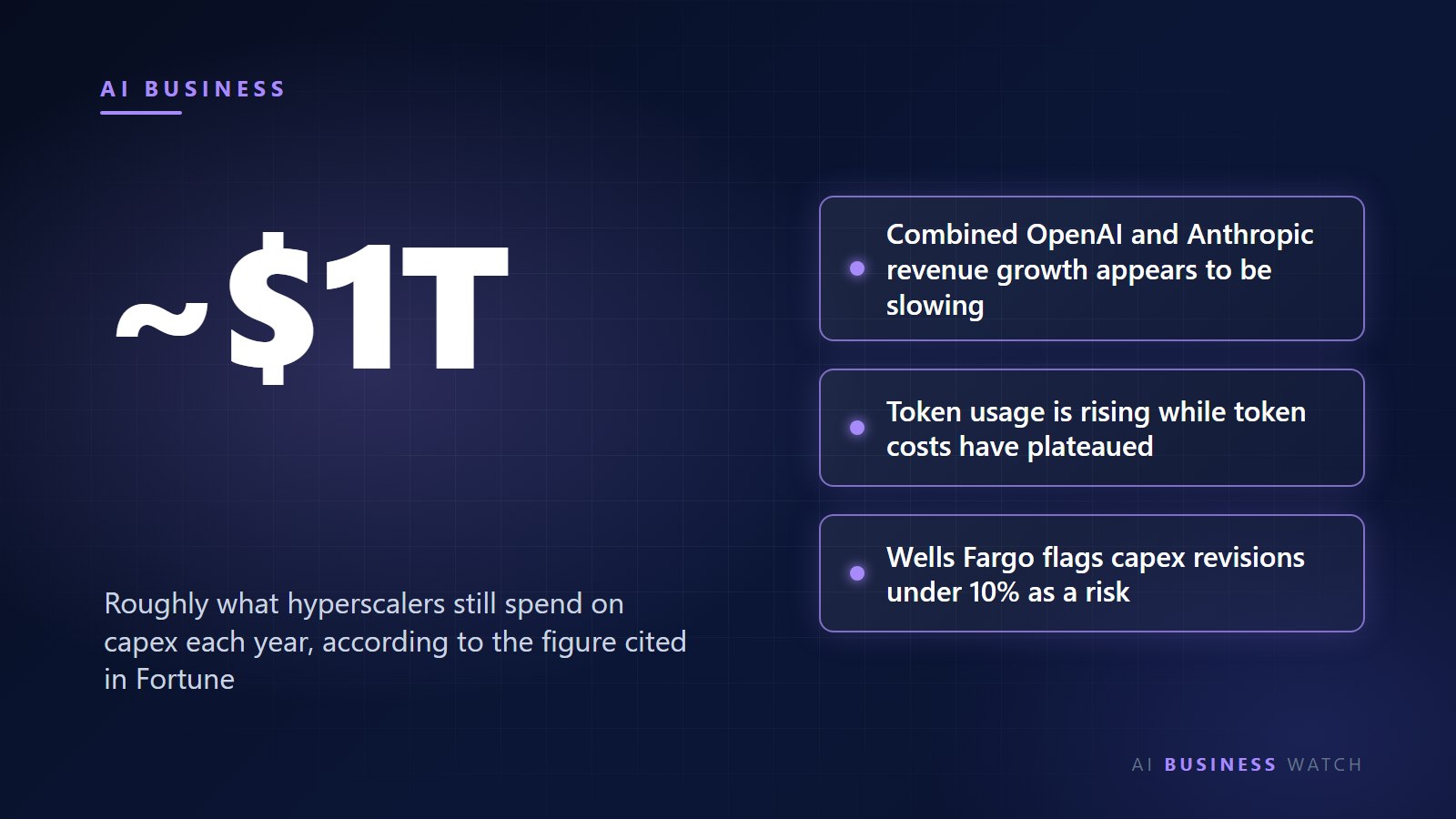
Fortune's Jim Edwards argues in his October 14 newsletter that the indicators of the AI boom are flattening, which could signal a peak. The conclusion is his interpretation of analyst notes, and he labels the section “How we know we're approaching the top of the AI boom.”
Lab revenue
According to Ohsung Kwon and Wells Fargo, combined revenue growth for OpenAI and Anthropic, both of which reportedly plan IPOs, appears to be slowing. The chart Edwards cites shows reported or rumored combined annual run-rates, but the text gives no dollar figures. Kwon's team says growth is still at a fast pace but is slowing, and that “Plateauing spend is concerning for frontier labs.” Token usage is rising while token costs have plateaued. Edwards offers a possible explanation: one large language model is much like another for 90% of tasks, so heavy users may shift to cheaper models. That figure is presented as an explanation, not a measurement.
Capex
Markets are used to large upward revisions to hyperscaler capex estimates. Kwon advised clients: “If capex estimates don't get revised up by more than 10%, we see that as a risk to AI buildout stocks.” Adrian Cox of Deutsche Bank and Lisa Shalett of Morgan Stanley show estimated capex growth slowing significantly, though the text gives no readable figures from their charts. Spending remains roughly $1 trillion a year. Shalett's note states: “Current consensus contemplates a different scenario in 2027.”
The reading
Edwards's only historical reference is the claim that “The law of large numbers appears to be kicking in.” He adds no other precedents. The 10% revision threshold as a risk signal, and Shalett's view that deceleration will be a headwind for equities, are analyst opinion.
Other data in the piece
ASML reported third-quarter profits above expectations and said customers are interested in orders through 2030. S&P 500 futures rose 0.21% that morning after the index closed flat on Tuesday. The article gives no titles for Kwon, Cox or Shalett.
Source: Fortune. This is an AI Business Watch summary of the original newsletter item.