
SiliconANGLE published an analysis on October 21 by Zeus Kerravala, principal analyst at ZK Research, on Nvidia's GTC Berlin keynote. The announcements are Nvidia's, and the conclusions are Kerravala's opinion.
What Nvidia announced
The keynote covered the DSX POD, a reference design for complete Vera Rubin AI factories built by partners in containers, which Nvidia says cuts deployment at a prepared site from six months to as little as 14 days. It also covered the OpenShell Reference Architecture for running agents safely, an expanded Agent Toolkit that includes an Agent Knowledge Foundation and Kumo, a family of structured-data models, and a deeper telecom push with Nokia and European operators. The DSX platform includes DSX MaxLPS, which Nvidia says delivers the same output with up to 30% less power, and DSX Flex, which automates grid curtailment requests.
Agents as the workload
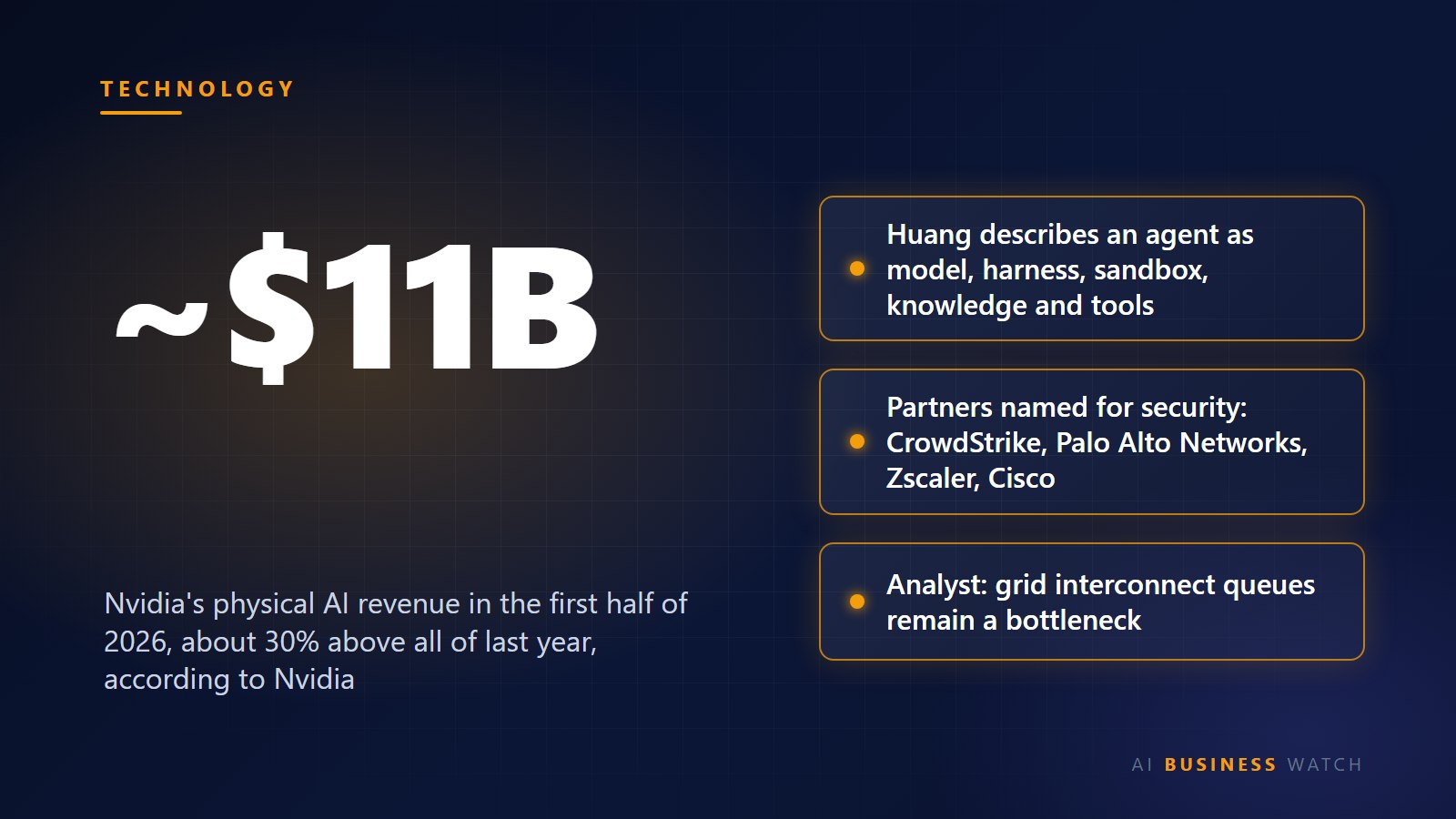
Nvidia said physical AI revenue reached nearly $11 billion in the first half of 2026, about 30% higher than all of last year. Huang described an agent as five parts: model, harness, sandbox, knowledge and tools. Harnesses run on Vera CPUs, models on Vera Rubin, and BlueField-4 with Nvidia Sentry acts as an isolated monitor. He said: “The agent is an autonomous system that has access to files, resources and networks,” and: “What turns these agents into super agents is giving them access to your company's knowledge.” Security partners named were CrowdStrike, Palo Alto Networks, Zscaler and Cisco, and the article notes T-Mobile and Nokia demonstrated the first AI-RAN call on a commercial network.
Kerravala's analysis
Kerravala argues Nvidia is moving from selling the key AI component to selling an operating model for AI. He says time to first token and time to revenue are the metrics that matter most to AI builders, that DSX POD shortens physical integration but grid interconnect queues remain a bottleneck, that security enforcement belongs in the network and not only on the host, and that telcos may succeed as distributed AI platforms where earlier edge efforts failed. He also agrees with Huang that AI will not end software companies.
Source: SiliconANGLE. This is an AI Business Watch summary of the original analysis.