
Cisco unveiled open silicon and optical networking systems in a keynote at the Open Compute Project Global Summit, SiliconANGLE's Mike Wheatley reported on October 12. The article describes networking as a major bottleneck in AI data centers, where clusters of thousands of accelerators must act as one processor.
The silicon
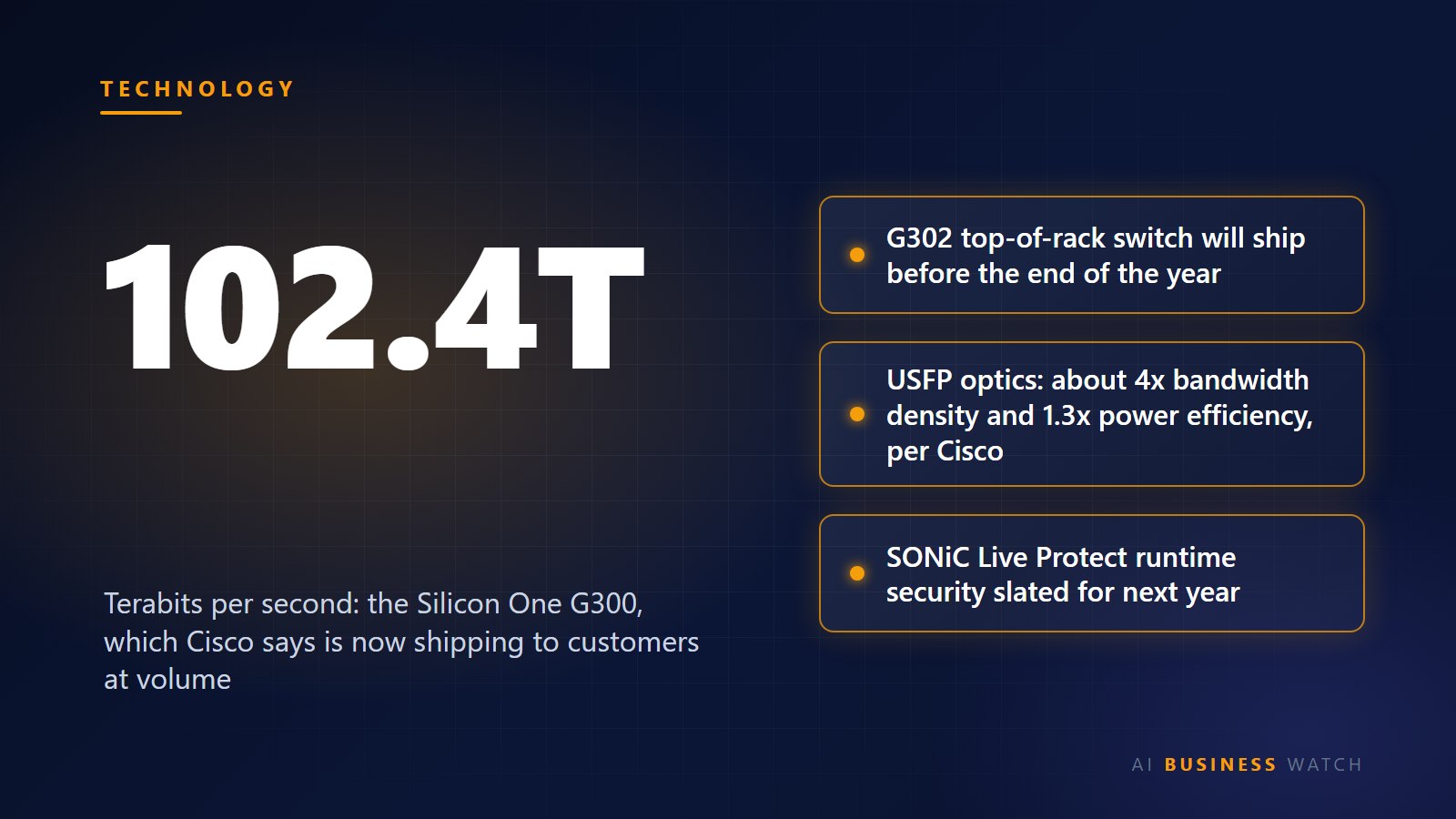
The Silicon One G300, a 102.4-terabit chip, is now shipping to customers at volume alongside new Silicon One P200 systems. Cisco also revealed the G302, a 51.2-terabit top-of-rack switch with a 200-gigabit serializer and deserializer interface that supports direct-to-chip liquid cooling and up to 1.6-terabit optics, and that will ship before the end of the year.
Repluggable optics with Nvidia
The Ultra-Dense Small Form Factor Repluggable module, or USFP, handles 400-gigabit-per-second-per-lane signals and packs 16 full-duplex lanes into a standard transceiver form factor for up to 12.8 terabits per second in total. Cisco claims about four times the bandwidth density and 1.3 times the power efficiency of existing 200G optics. The partners say the design eliminates complex embedded cooling circuits and uses a two-dimensional array connector with a two-step insertion design. Nvidia's Gilad Shainer said: “Building the world's largest AI factories starts with rethinking the smallest of connections.”
Management and software
The Cisco 8001 is an out-of-band network management system powered by Silicon One A100 chips, meant to replace fragmented legacy tools during outage recovery. A new open-source SONiC release features Live Protect, a runtime security feature slated for availability next year that Cisco says remediates vulnerabilities in live AI workflows without disruption.
Scale-across
Cisco describes a scale-across architecture that links distributed AI data centers into a unified compute fabric using more coherent optics and deep-buffered systems. Kevin Wollenweber, senior vice president and general manager of data center and internet infrastructure, said: “It's no longer just about individual data centers or clusters.” The stack is designed for hyperscalers, neoclouds and enterprises, and the article names no specific customers.
Source: SiliconANGLE. This is an AI Business Watch summary of the original report.